
Quartz or graphite crucible? The choice depends on what you melt, the temperature required, and the contamination your process can tolerate. Both handle high-temperature work in casting, semiconductor growth, and labs, but their properties suit different tasks. A graphite crucible withstands extreme heat and thermal shock. A quartz crucible offers purity and chemical inertness but lower thermal durability. Knowing where each fails teaches more than any comparison chart.
What a Graphite Crucible Brings to High-Temperature Melting
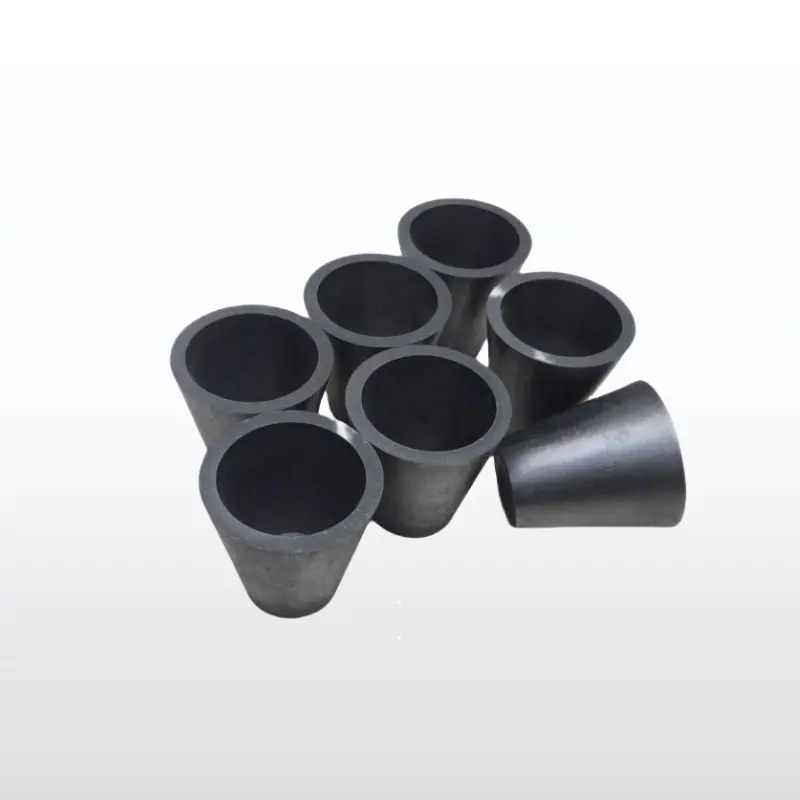
A graphite crucible is made from natural or synthetic graphite mixed with clay or pitch binders, then fired into a dense, thermally conductive container. Its defining trait is temperature capability. In a protective or reducing atmosphere, graphite stays stable at temperatures that soften most ceramics well past the melting points of gold, silver, copper, and platinum. This makes it hard to replace in precious metal refining, induction melting, and non-ferrous foundry work.
Thermal shock resistance is another advantage. Heating from cold to full operating temperature in minutes won’t crack or spall the wall as it would with quartz. This suits batch melting where the crucible cycles between room and furnace temperature multiple times daily.
Where Graphite Crucibles Deliver Their Best Results
The typical user of a graphite crucible is melting metals in an induction furnace or a gas-fired pit furnace. Jewelers, dental labs, small-scale gold refiners, and foundry sample labs all rely on them for consistent melt containment. Specific application areas include:
●Precious metal melting and refining: Gold, silver, platinum group metals, and their alloys melt cleanly in graphite crucibles without excessive wetting or ceramic contamination. The inert atmosphere inside an induction furnace protects the graphite from oxidation, and the crucible delivers clean pours into ingot molds or centrifugal casting fixtures.
●Non-ferrous alloy preparation: Copper, brass, bronze, and aluminum alloys are routinely melted in graphite crucibles, especially where the melt shop runs small batch sizes and needs a crucible that lasts through hundreds of thermal cycles without cracking.
●Laboratory sample preparation: Analytical labs use small graphite crucibles for fusion sample preparation in XRF and ICP workflows, where the sample is heated with a flux and poured into a glass disk. Graphite’s thermal conductivity ensures fast, even heating.
●Vacuum and controlled-atmosphere processes: In vacuum induction melting or inert gas environments, graphite crucibles avoid the oxidation problem entirely and serve as long-life consumables that withstand repeated exposure to molten metals.
The key weakness of a graphite crucible is oxidation. Above about 400 degrees Celsius in open air, it erodes from the surface inward. Without protection, it becomes a short-lived consumable. This is the core operational difference: graphite needs atmosphere control or a protective coating; quartz handles oxidizing conditions natively.
Where Quartz Crucibles Excel
A quartz crucible is made from high-purity fused silica, offering chemical resistance and optical clarity that graphite cannot match. It tolerates prolonged contact with acids, halogens, and oxidizing atmospheres that would destroy graphite in minutes. Semiconductor crystal growth, especially Czochralski pulling of monocrystalline silicon, relies on quartz crucibles to keep the silicon melt free of carbon contamination. Graphite in the same role would introduce carbon and alter the electrical properties of the finished wafer.
Quartz crucibles also handle ashing, calcination, and acid digestion in analytical chemistry where samples must avoid metal or carbon traces. Their optical transparency lets operators monitor melt conditions visually something opaque graphite walls prevent.
Temperature and Thermal Shock: The Trade-Off
Quartz crucibles have a lower temperature ceiling than graphite. Standard fused quartz softens noticeably above 1200 to 1250 degrees Celsius, while graphite holds structural integrity past 2000 degrees Celsius in an inert or reducing environment. Quartz works for melting high-purity silicon supported by a graphite susceptor but for superalloys, reactive metals, or brazing filler metals, graphite is the practical choice.
Thermal shock resistance differs sharply. Quartz cracks under rapid temperature changes, splintering if moved from cool ambient into a hot furnace without a controlled ramp. Graphite handles the same shock without damage. Quartz crucibles need slow, controlled ramping; graphite crucibles can be placed directly into a hot induction coil and powered up.
Making the Choice for Your Process
The decision path is reasonably direct once the priorities are clear:
1.If temperature exceeds 1250 degrees Celsius and atmosphere can be controlled, a graphite crucible is the natural choice.
2.If the process requires chemical inertness in oxidizing conditions or demands zero carbon contamination, quartz is the selection.
3.If thermal cycling is rapid and frequent, graphite provides the toughness. Quartz demands gradual heating and cooling.
4.If optical visibility into the melt matters, quartz offers it.
5.If budget for consumables is tight and atmosphere control is available, graphite generally costs less per melt cycle for high-volume precious metal work than quartz of equivalent size.
No single crucible material fits every application. Graphite and quartz each solve distinct thermal and chemical problems. Recognizing which problem your process creates makes the right choice obvious. For anyone setting up a melting operation or troubleshooting contamination in an existing line, crucible material is one of the first variables to review. It sits at the center of the thermal process, and a mismatch spreads problems downstream through the entire workflow.
Post time: May-16-2026