
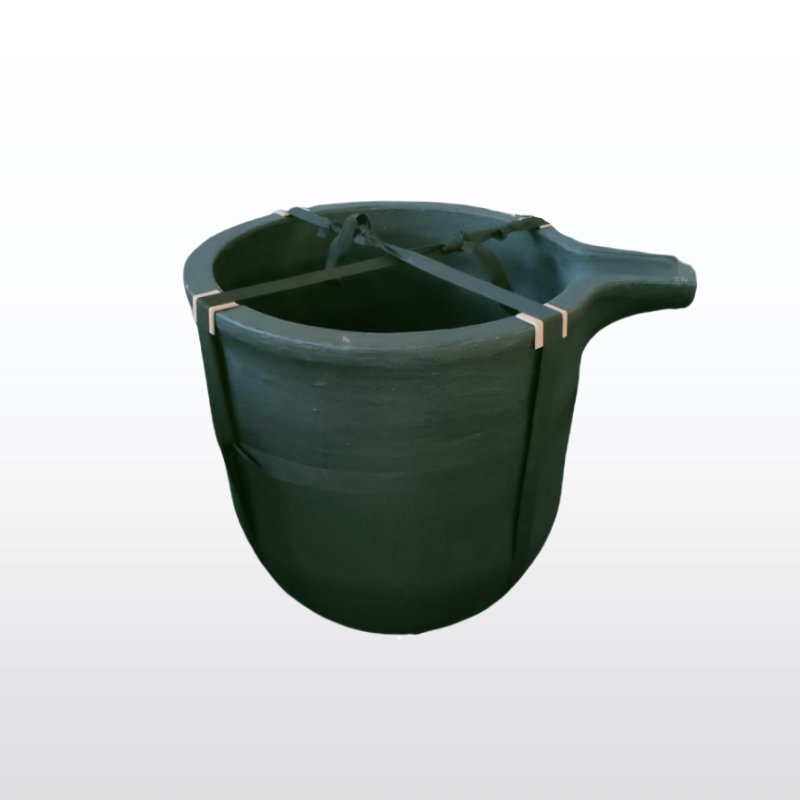
Graphite Crucible Metal melting and processing have greatly benefited from the use of graphite crucibles because they function well in extreme temperatures as a crucial melting apparatus. Numerous industries, including metallurgical, jewelry casting, and experimental laboratories employ graphite crucibles because these facilitate an effective start in the melting process. This guide introduces everything one should know about graphite crucibles including their types; their main applications; some tips on how to choose the right type of a crucible; useful instructions on how to maintain your crucible; and valuable advice on how to choose the right crucible.
What Is a Graphite Crucible?
A graphite crucible is a type of crucible containing a significant amount of graphite and can perform its function under high temperatures as well as fast heating and cooling cycles of the process. Graphite is different from other materials as it is thermally and chemically steadfast. The only limitation of graphite crucibles is that they work efficiently at a temperature of 1600ºC (about 2912ºF) which makes them applicable for melting many kinds of metals, including gold, silver, copper, aluminum, brass, and their alloys. The chemical stability and thermal resistance of graphite crucibles make clean and uncontaminated melts possible in precise operations.
Types of Graphite Crucibles
There are several types of Graphite Crucible, each suited to specific conditions:
Clay Graphite Crucible is a mixture of clay and graphite and is famous for its durability and ability to tolerate thermal stress when melting metals without ferrous components.
The Silicon Carbide Graphite Crucible made of graphite and silicon carbide is popular for its ability to withstand oxidation and mechanical strength and is used for precious metal purification and continuous casting.
Isostatic Graphite Crucible has properties of uniform density that lead to better use and longer span of life with its application for laboratory work.
Pure Graphite Crucible is almost 100% graphite that is used for works requiring high purity level, like laboratory research and clean casting.
Specialty Crucibles is a custom-made crucible for some specific needs in processes like vacuum processing and induction furnaces.
Key Advantages and Properties
Graphite crucibles stand out because of their:
● High Thermal Conductivity: Supports effective heating process.
● Excellent Thermal Shock Resistance: Enables rapid temperature variation without breaking.
● Chemical Inertness: Reduces reactions or contamination risk.
● Working Temperature Limit: Ideal for melting most metals up to ≤1600°C, which is less than graphite’s theoretical melting temperature but still a safe operating region.
In comparison to ceramic alternatives, graphite crucibles are lightweight, easy to craft, and inexpensive. These characteristics enable them to be employed in many industrial as well as artisanal applications.
Common Uses of Graphite Crucibles
Graphite crucibles play a vital role in:
● Metal Casting and Melting: Utilized in metalwork, jewelry production, and recycling as a method to liquefy a variety of metals.
● Laboratory and Research Usage: Preferred for conducting experiments and creating materials at extreme temperatures.
● Semiconductor Production: Used in the growing of pure silicon crystals.
● Glass Production: Employed in the melting of chemical and mineral components.
● Brazing and Soldering: Required for joining metals and processes where the metal has to retain its properties at the given temperature.
How to Choose a Graphite Crucible
When selecting a Graphite Crucible, consider:
Material Suitability: Confirm that your crucible is suitable for the metals you want to work with.
Dimensions / Configuration: Select the correct size and configuration for both your furnace and batch.
Heat Tolerance: Confirm that the crucible can operate up to the required temperatures (≤1600°C).
Furnace Type: Ensure that the heating type matches the crucible used (gas, electric, induction).
Durability: Ensure the expected life span taking into consideration usage conditions and frequency.
Buy from trustworthy suppliers who provide technical assistance and explicit specifications. Dependable quality lowers the chances of contamination or damage and guarantees a better outcome.
Maintenance and Care Tips
Proper care will extend the life and performance of your Graphite Crucible:
Storage: Store crucibles in a dry place where they will not be exposed to moisture or abrupt changes in temperature.
Pre-heating: Preheat crucibles gently prior to first use to get rid of moisture.
Cleaning: Use only soft brushes for the removal of residue, do not use metal or chemical scrapers.
Inspection: Check crucibles regularly for cracks and wear before each use and do replacement when necessary.
Frequently Asked Questions (FAQ)
Can a graphite crucible melt steel?
Generally no. Graphite crucibles are best for metals with melting points below 1600°C, such as gold, silver, copper, and aluminum.
How many times can a graphite crucible be reused?
It depends on use conditions. With proper preheating, gentle cleaning, and dry storage, a crucible can last for many cycles.
Why does my graphite crucible crack?
Cracks often come from moisture, rapid heating, or thermal shock. Preheat slowly and avoid sudden temperature changes.
Buying Tips
When purchasing Graphite Crucible products:
- Look for assistance in the technical aspects and check if any product warranty is available.
- Focus on the examination of product life span and material certification.
- Request for samples in case of the information is unclear.
- Investigate suppliers’ reviews regarding their dependability and product quality.
Graphite crucibles are the most used type of crucible when it comes to high temperature melting & casting. By knowing about the various types of graphite crucibles, their main advantages and uses, along with some tips on how to choose your crucibles and take care of them, a great result can be achieved in a safe way. Keep in mind that the maximum temperature for graphite is 1600 degrees Celcius, if it is selected properly and maintained in a right way, it will provide a wonderful results at a reasonable cost for various industries and projects.
Post time: Oct-13-2026